
How We Help UK Businesses Turn AI Into Practical Return
Whether you are exploring where to start, frustrated by underwhelming off-the-shelf AI trials, or looking to connect scattered pockets of AI use into measurable operational capacity, we help across three connected areas.
Starting From Where Your Business Actually Is
Every business we speak with is at a slightly different stage with AI:
- check_circleExploring: People in the business have already used chatbots and tried early experiments, but you do not yet have a clear strategy and have held back from committing serious budget until you can see a reliable business case (£).
- check_circleTried With Mixed Results: Gone beyond basic chatbots with several AI tools, only to find they struggle with complex spreadsheets, multi-column PDFs, and specific company rules - creating plenty of activity with no clear business benefit.
- check_circleActive in Pockets: Certain individuals or teams (such as developers) are already getting real wins from AI, while customer-facing, administration, compliance workflows, and older software systems largely still take the same manual effort as three years ago.
Rather than forcing every business into a single template, we help leadership teams across three practical areas.
1. AI Readiness, Strategy & Practical Governance
For Managing Directors, CEOs, and Leadership Teams
Before spending money on new software or automation projects, leadership needs clear visibility of where AI will genuinely pay back - and where unverified blindspots sit.
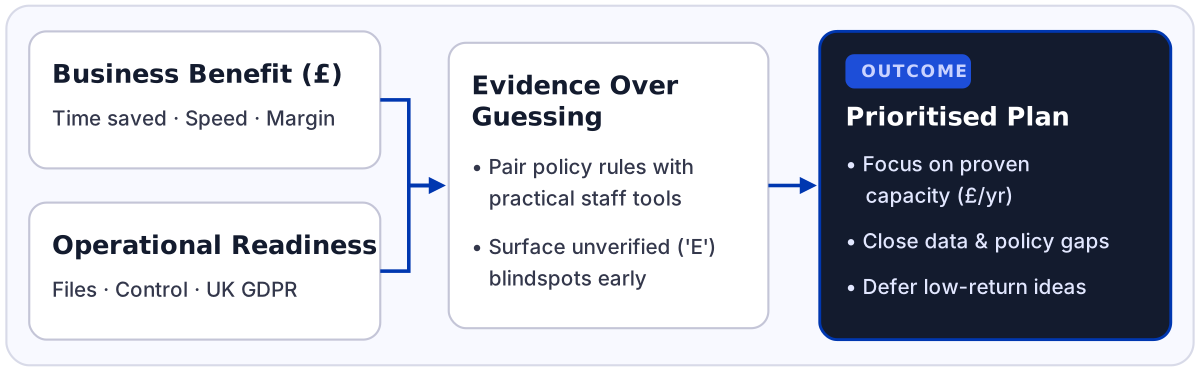
- check_circleIndependent Readiness & Business Benefit Reviews: Identifying which recurring workflows carry the highest recoverable team capacity (£/year) and which ideas should be deferred.
- check_circleAligning Policy With Practical Staff Tooling: Even the best data-protection policy will be bypassed if busy staff are told not to use public chatbots without being given safe, effective tools that genuinely help them do their jobs. We help you pair clear UK GDPR and ICO-aligned policies with practical tools your team prefers using.
- check_circleOngoing Executive Guidance (Fractional AI Leadership): Acting as an experienced, vendor-independent technical peer alongside your leadership team to vet suppliers, oversee delivery, and steer priorities without the cost of a full-time executive hire.
2. Operational Workflow & Company Knowledge Automation
For COOs, Operations Directors, and Service Leaders
In most growing businesses, 25% to 50% of skilled customer-facing, administration, and compliance time is tied up in recurring enquiry triage, drafting responses, document checking, CRM flows, and re-keying information across operational tools your business already uses.
- check_circleControlled Workflow Automation: Automating repetitive tasks - reducing operational costs, improving customer satisfaction and quality of service, and improving staff happiness by freeing your people for more creative, higher-value activity.
- check_circleStaff Sign-Off & Gradual Automation: No workflow goes straight to blind autopilot. Every automated step starts with 100% staff review in a clear sign-off queue, stepping down gradually only as your team sees proven accuracy in practice.
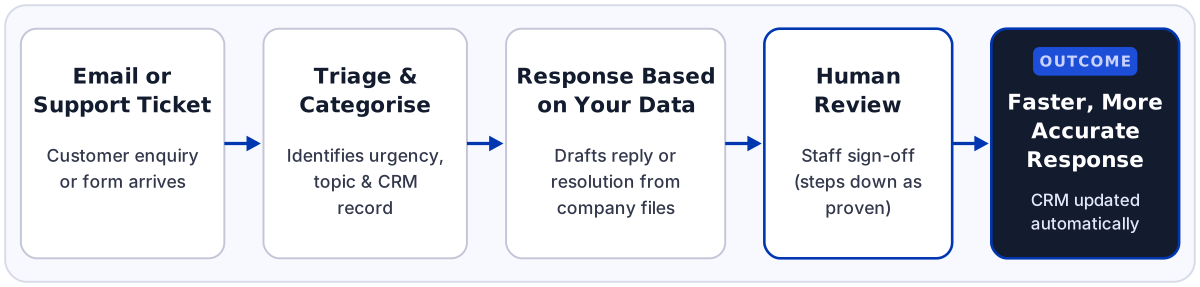
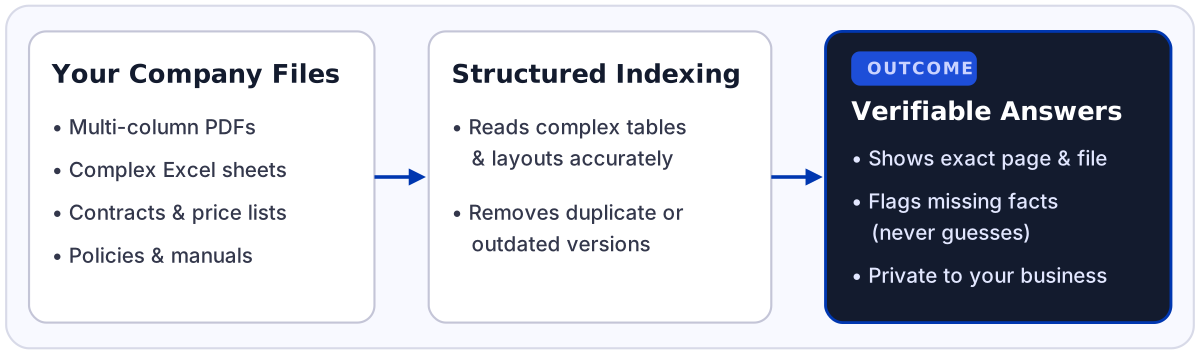
- check_circleAccurate Answers From Your Own Company Files: Organising your policies, contracts, manuals, and spreadsheets so your team can get instant, verifiable answers that show the exact page they came from - and clearly flag when information is missing rather than guessing.
3. AI-Assisted Software Delivery & Legacy Modernisation
For CTOs, Technical Directors, and Businesses Reliant on Older Software
Software engineering is often the first area to adopt AI coding assistants, but generating code faster rarely improves overall delivery if senior engineers become overwhelmed reviewing large, inconsistent pull requests - or if the business is held back by an aging core system.
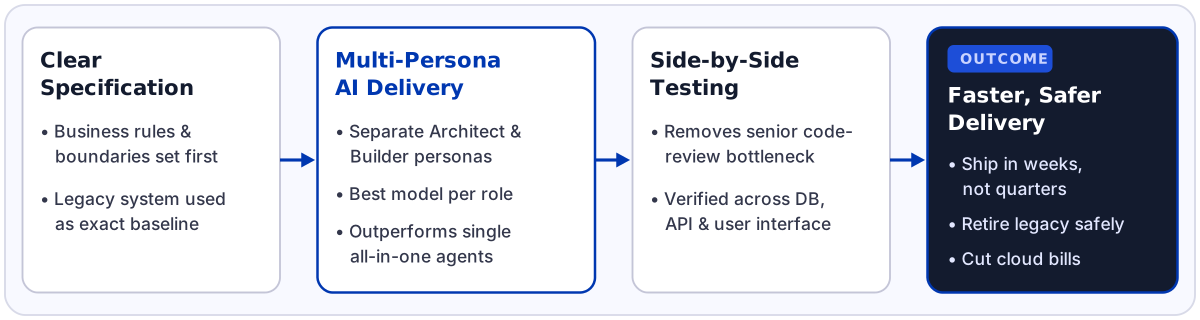
- check_circleFaster, Cleaner Software Releases (Multi-Persona AI Delivery): Single coding agents often lose context and mark their own homework when asked to design, code, and test in one place. We help teams adopt a disciplined multi-persona operating practice - separating architectural design from code execution and matching the right AI model to each role - so features ship faster without overwhelming senior engineers in code review.
- check_circleLow-Risk Legacy Application & Cloud Modernisation: Retiring expensive legacy systems (such as aging PHP, .NET, or Java applications) safely by testing the new system side-by-side against your existing one before switching over, while cutting monthly cloud hosting bills.
- check_circleRapid Custom Business Applications: Building focused internal tools, client portals, and integrations in weeks rather than quarters when off-the-shelf SaaS is too rigid or expensive.
Where to Start: The AI Readiness & Business Benefit Assessment
The simplest way to identify where these three areas apply to your business — and to see our governed workflow in action — is our AI Readiness & Business Benefit Assessment.
In 15 to 20 minutes, it benchmarks your business benefit and operational readiness across 20 core questions (plus 4 optional software questions), and provides a tailored Executive Scorecard quantifying your indicative recoverable team capacity (£/year) and priority next steps.